National unity most important will of martyred Leader of Islamic Revolution: Custodian

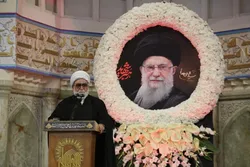
Ayat. Ahmad Marvi, the Custodian of Astan Qods Razavi (AQR), says all those concerned about Iran should unite under the banner of national unity, stressing that unity is the most important legacy and will left by the martyred Leader of the Islamic Revolution.
Addressing people on the evening of March 31 during a large public gathering in Janbazan Square in Mashhad, northeast Iran, AQR Custodian pointed to the historic vote of the Iranian people for the Islamic Republic on April 1, 1979, saying: “More than 98 percent of Iranians voted in favor of the Islamic system of government”.
He added that from the earliest days, enemies of Iran and adversaries of the country’s independence and strength sought to undermine and destroy the system.
“Over the past 47 years, adversaries have used every available tool, including fomenting internal conflicts, provoking militant groups, creating ethnic tensions, imposing an eight‑year war, and imposing sanctions”, he said.
Ayat. Marvi added: “Their objective was either to force the Islamic system to surrender and absorb it into the global order they favor or to eliminate it entirely”.
Stating that despite these efforts, the enemies have failed to achieve their goals, he explained that several key factors contributed to the system’s resilience.
The first factor, he said, is divine support. “The Islamic Republic was founded on piety and God‑centered principles”.
He continued: “Imam Khomeini established the Islamic system seeking divine satisfaction, the elevation of truth, opposition to oppression, and defense of the oppressed”.
The second factor, he noted, is leadership. “Imam Khomeini and the martyred Leader of the Islamic Revolution consistently relied on faith in God and never showed weakness or retreat in the face of enemies”.
He added that they remained firmly committed to the values and ideals of the revolution.
Citing verses from the Holy Quran, the top official stated: “God promises support for those who defend the faith, and belief in this promise removes fear of material powers”.
He described the awareness and vigilance of the people as the third major factor in preserving the system. “The presence of the people in different arenas throughout the past decades has repeatedly frustrated the plans of the country’s enemies”.
Ayat. Marvi emphasized that it is the people who preserved and protected the Revolution.
Quoting the martyred Leader of the Islamic Revolution, he said: “The people themselves have played a guiding role and can be considered the true leaders of the Revolution”.
He stressed that even strong faith and capable leadership cannot achieve results without public participation.
Referring to Imam Ali’s leadership in early Islam, he noted: “Despite his unparalleled spiritual status and closeness to Prophet Muhammad, the absence of public support prevented him from exercising leadership for 23 years”.
The Custodian of Astan Qods Razavi went on to say: “Iranian society today benefits from faith in God, strong leadership, and a patient, dignified, and honorable people”.
He said Imam Khomeini’s statement that even prophets did not have such devoted followers reflects the exceptional nature of the Iranian people.
Referring to the tragedy of Ashura, the top cleric said: “If Imam Hussein had enjoyed such public support and awareness among the people of Mecca and Kufa, the tragedy of Karbala would not have occurred”.
Ayat. Marvi described the conscious presence of the public as the greatest asset of the system.
He particularly praised the participation of young people who continue to stand by the country despite challenges, hardships, and criticism.
“Whenever people perceive a threat to the country, territorial integrity, Islam, the Quran, or the Islamic system, they put aside differences and stand united,” he said.
He added that the Iranian people possess strong insight and are able to determine priorities during critical moments.
According to him, whenever danger threatens the country, God inspires the people to rise in defense of it.
Ayat. Marvi described the enthusiasm and mobilization of the public as a form of divine mission. “As long as enemies continue hostility and refuse to recognize the rights of the Iranian nation, confrontation will continue until those adversaries abandon their aggression”.
Ayat. Marvi also referred to what he described as miscalculations by Iran’s adversaries, saying: “Some opponents believed they could force Iran into surrender within three days and promised neighboring countries that the conflict would be short and would not spread across the region”.
“However, weeks later, those expectations have not been realized due to the resistance of fighters and the decisive role of the people”, he stressed.
He also referred to threats made through media campaigns about the deployment of large aircraft carriers such as the USS Abraham Lincoln and USS Gerald Ford.
Elaborating on the reasons why such forces have failed to achieve their declared objectives, he said: “The situation demonstrates that the perceived power of adversaries is largely exaggerated through media propaganda”.
The top official stressed the importance of strengthening national cohesion, saying: “The umbrella of national unity should be expanded to include all segments of society”.
Every Iranian who cares about the country, he said, should have a place under this banner.
He emphasized the need for a policy of maximum inclusion, adding: “Even those who do not support the political system but love Iran should be allowed to participate within this framework”.
According to AQR’s head: “The circle of national solidarity should not be narrowed by restrictive divisions or judgments based on appearance or personal differences”.
Anyone who values Iran and proudly raises its flag, he said, deserves respect and acceptance.
He also called for a compassionate approach toward young people influenced by misleading propaganda or deviant movements. “Such individuals remain children of the nation and should be guided through dialogue, clarification of facts, and gaining awareness.”
He added that individuals working as agents for hostile forces should be treated differently.
Ayat. Marvi recalled repeated calls from the martyred Leader of the Revolution emphasizing unity as the key factor in neutralizing enemy conspiracies.
He said the enemy fears unity and benefits from division or polarization within society.
Referring to the phrase “sacred unity,” he said: “It reflects the spiritual and moral importance of unity within Islamic society”.
The Custodian of Astan Qods Razavi also highlighted the importance of public trust in political officials and support for the country’s armed forces and administrators.
Creating doubt or distrust among the public, he warned: “Only weakens national cohesion and benefits adversaries”.
He continued by emphasizing that the martyred Leader of the Islamic Revolution repeatedly highlighted unity and solidarity as essential principles.
According to him, preserving this legacy is crucial for protecting both Iran and Islam.
He said, in conclusion, that if the system suffers serious damage, Islam itself would be harmed; therefore, safeguarding the country and the foundations of Islam must remain the first and foremost priority.
Related News


Post comments
- Editor's suggestion
- Latest news
IRIU, Ministry of Foreign Affairs forge scientific diplomacy ties
Future diplomats tour Imam Reza Shrine
Iraqi students visit Imam Reza Shrine
Razavi University, al-Mustafa International University launch joint cooperation center
Malek Museum unveils exhibition on devotion to Prophet Muhammad
Khorasan Razavi MPs support AQR development plans for Imam Reza Shrine
AQR research deputies strengthen international synergy
Darvazeh Bathhouse reflects Safavid-era history in Mashhad: Expert
Sunni influencer recalls shattered stereotypes during visit to Imam Reza Shrine
International Islamic Unity Conference continues strategic vision of Iran’s leaders
Iran is a unique model of peaceful coexistence: Muslim activist
Imam Reza Shrine plays pivotal role in Islamic unity: Bahraini scholar
40th Islamic Unity Conference concludes in Mashhad
40th Islamic Unity Conference concludes in Mashhad
Imam Reza Shrine adorned for birth anniv. of Prophet, Imam Sadiq
Arab pilgrims honor birth anniv. of Prophet, Imam Sadiq
Afghan collector donates rare stamps to AQR
Imam Reza Intl. University, Razavi University expand international cooperation
AQR Custodian meets martyr Larijani's family members
Intl. landscape design and memorial space competition for Shajareh Tayyebeh School martyrs' cemetery
Dust-cleaning ceremony held at Imam Reza Shrine
Campaigns